There is a statement David once made that takes on an entirely different meaning when we bring it to the cross. David had sinned. Judgment was coming. When given a choice concerning what would happen, he answered, “I am in a great strait: let us fall now into the hand of the LORD; for his mercies are great: and let me not fall into the hand of man.” 2 Samuel 24:14.
David understood something about God that desperately needs to be understood today. Even under judgment, David would rather fall into God’s hands than into the hands of men, because “His mercies are great.” Men can become cruel. Men can torture, humiliate, mock, and kill without pity. David feared what human beings could do once restraint was removed.
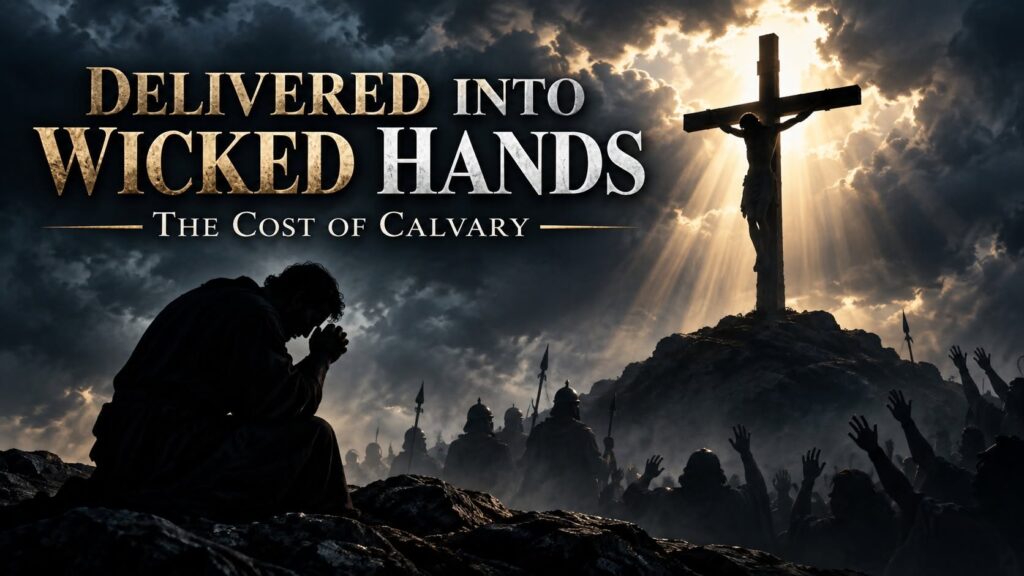
And yet, in order to save David, and to save us, God permitted something terrible to happen to His own Son. Paul writes, “He that spared not his own Son, but delivered him up for us all…” Romans 8:32. Peter tells us whose hands received Him: “Him, being delivered by the determinate counsel and foreknowledge of God, ye have taken, and by WICKED HANDS have crucified and slain.” Acts 2:23.
David had pleaded, “Let me not fall into the hand of man.” But Christ was delivered into the hands of men. Wicked hands struck Him. Wicked hands scourged Him. Wicked hands pressed thorns into His brow. Wicked hands drove nails through His flesh. And behind those human instruments stood a still darker power, for when Jesus was arrested He said, “This is your hour, and the power of darkness.” Luke 22:53.
The Father did not cease loving His Son. The Father was not the enemy of Christ. But the Father gave His Son up to enter the terrible place into which sin ultimately brings the sinner—the place where divine protection is withdrawn and the powers of darkness are allowed to do their work.
FROM THE FORM OF GOD TO A BODY PREPARED TO SUFFER
Before Bethlehem, Christ was “in the form of God.” He shared the glory of His Father. He was adored by the heavenly host. He knew no scourge, no nails, no crown of thorns, no hunger, no thirst, no physical agony and no death. He was the beloved Son dwelling in the glory of heaven.
Then Christ said, “A body hast thou prepared me.” Hebrews 10:5.
Think about what that body meant. Human flesh could become hungry. It could become exhausted. It could bleed. A back could be ripped open by a Roman scourge. Hands could be pierced. A brow could be torn by thorns. Lungs could struggle for breath upon a cross. A human body could suffer torture and finally die.
Paul says that Christ, “being in the form of God,” took “the form of a servant,” was “made in the likeness of men,” and “humbled himself, and became obedient unto death, even the death of the cross.” Philippians 2:6-8. He came from the worship of angels to the mockery of sinners; from heavenly glory to human flesh; from the presence of His Father to the terrible cry, “My God, my God, why hast thou forsaken me?”
ABRAHAM SHOWS US SOMETHING OF WHAT THIS COST THE FATHER
Long before Calvary, God took a father through an experience designed to open to human minds something of the cost of redemption: “Take now thy son, thine only son Isaac, whom thou lovest…” Genesis 22:2.
Every word matters: thy son… thine only son… whom thou lovest. Isaac was the miracle child. Abraham had waited decades for him. God had specifically promised, “In Isaac shall thy seed be called.” Hebrews tells us Abraham was willing to offer the very son upon whom the promise rested because he believed God could raise him from the dead.
Paul later tells us that the promise ultimately centered in one Seed: “And to thy seed, which is Christ.” Galatians 3:16. “Christ” means the Anointed One, the Messiah. Isaac was not himself the ultimate Messiah, but to Abraham the whole future of the promised Seed was bound up with Isaac. If Isaac died, how could the promise be fulfilled? Yet Abraham trusted God enough to raise the knife, believing that even death could not make God’s promise fail.
Imagine what was happening in that father’s heart. Abraham was prepared to take the life of his own beloved son with his own hand. But God stopped him: “Lay not thine hand upon the lad.” Then Abraham saw the ram caught in the thicket. God had provided a sacrifice. A substitute died and the beloved son went free.
But when we come to Calvary, there is a terrible difference.
God spared Abraham’s son. But He did not spare His own.
Abraham never had to bring the knife down. At Calvary there was no voice saying, “Do not touch My Son.” There was no other animal waiting to take Jesus’ place. Jesus was the Substitute.
SOMETHING EVEN HARDER THAN ABRAHAM’S KNIFE
Imagine having a beloved animal that must die. It would be heartbreaking to hold that animal while a veterinarian gently administered a lethal injection. But imagine something far worse: opening a gate and releasing that beloved animal alive into a pack of wolves, then standing close enough to hear what they were doing while possessing the power to stop them.
Which would be harder?
Abraham was prepared to take Isaac’s life himself. But the Father did not personally drive the nails into Jesus. He surrendered His beloved Son into the hands of His enemies. He permitted the wolves to surround Him. He permitted Judas to betray Him, the mob to seize Him, soldiers to scourge Him, priests to mock Him, and Roman hands to crucify Him.
Christ Himself said that twelve legions of angels were available to Him. Heaven possessed unlimited power to interpose. But heaven did not interpose. The Father allowed His Son to be delivered into “wicked hands,” and the Son willingly submitted.
WHEN GOD NO LONGER INTERPOSES
This brings us to one of the most solemn truths in Scripture and in Ellen White’s writings. Not every judgment of God operates in precisely the same manner. Ellen White explicitly speaks of holy angels exercising destructive power “when God commands,” while evil angels exercise destructive power “when He permits.” The Great Controversy, p. 614.
There is therefore a terrible form of divine judgment in which God does not send the destructive blow directly. Instead, after warning, pleading, correcting, restraining, and protecting, God finally allows those who have persistently rejected His voice to experience the master they have chosen.
But notice carefully who Ellen White was talking about when she described this. Before saying that these judgments would not come directly from God, she wrote:
“I was shown that the time was in the near future that these whom God had warned and reproved and given great light but who would not correct their ways and follow the light, He would remove from them that heavenly protection which had preserved them from Satan’s cruel power.”
She continues that they would be “left to themselves,” that God’s protection would be withdrawn, and that they would no longer be shielded from Satan. Then she explains: “I was shown that the judgments of God would not come directly out from the Lord upon them, but [rather] in this way: they place themselves beyond His protection.” She says God had warned, corrected and reproved them repeatedly, but when they finally chose their own course, “He does not commission His angels to prevent Satan’s decided attacks upon them.” Letter 14, 1883; Manuscript Releases, vol. 14, pp. 2-3.
Ellen White is not saying that every judgment anywhere in Scripture is merely God withdrawing protection. In the same body of writings she explicitly speaks of holy angels destroying when God commands. Here she is describing a particular class of people: people whom God has warned, reproved, protected, and given great light, yet who deliberately refuse to walk in that light.
And that makes this judgment even more frightening.
GREATER LIGHT—GREATER GUILT
The Bible repeatedly teaches that judgment is according to light received. Jesus said, “That servant, which knew his lord’s will, and prepared not himself, neither did according to his will, shall be beaten with MANY STRIPES.” Luke 12:47.
Why many stripes? Because he knew. Greater knowledge brings greater responsibility.
Ellen White expresses the same principle: “There is still another class who have had great light and special conviction, and a genuine experience in the workings of the Spirit of God; but the manifold temptations of Satan have overcome them.” Testimonies for the Church, vol. 3, p. 361.
She makes it stronger elsewhere: “It shall be more tolerable for Sodom and Gomorrah in the day of judgment than for those who have had the privileges and the great light which shines in our day, but who have neglected to follow the light.” Testimonies for the Church, vol. 3, p. 380.
Sodom was terribly wicked. Yet Jesus taught that there are people whose guilt can actually exceed Sodom’s because they sinned against greater light. The principle is sobering: sin against light brings greater guilt than sin in ignorance.
Israel experienced this same principle in the wilderness. Ellen White says that earlier God had pitied their “ignorance and blindness,” but after Sinai they had “received great light,” and therefore their rebellion “incurred the greater guilt.” Patriarchs and Prophets, p. 379.
The greater the light rejected, the more solemn the judgment.
JERUSALEM: GREAT LIGHT REJECTED UNTIL GOD WITHDREW
This is exactly what happened to Jerusalem. No city had received greater privilege. Prophets had walked its streets. The temple stood within its walls. Christ Himself taught there. He healed their sick, opened blind eyes, cleansed lepers, raised the dead, and pleaded with their leaders.
Then He stood overlooking Jerusalem and wept: “O Jerusalem, Jerusalem… how often would I have gathered thy children together… and ye would not!”
Notice those words: “I would… ye would not.” God was not trying to destroy Jerusalem. He was trying to gather her. But light repeatedly rejected eventually becomes judgment.
Ellen White writes that Jerusalem finally “rejected the last offer of mercy.” Then: “God withdrew His protection from them and removed His restraining power from Satan and his angels, and the nation was left to the control of the leader she had chosen.” —The Great Controversy, p. 28.
That is terrifying. They chose a leader other than God, and eventually God gave them over to the leader they had chosen. She later explains that the horrible cruelties surrounding Jerusalem’s destruction demonstrated “Satan’s vindictive power over those who yield to his control.”
This was not because Jerusalem lacked light. It was because Jerusalem had been given enormous light and rejected it. Their judgment was greater precisely because their privilege had been greater.
This is why Ellen White could say that it would be more tolerable for Sodom than for people who receive great light and refuse to walk in it. She even wrote of professed Christians who abused God’s mercy: “This class are laying up for themselves a fearful retribution, when God in his wrath shall visit them with his judgments.” Testimonies for the Church, vol. 4, p. 191.
NOW COME BACK TO THE CROSS
This makes Calvary almost unbearable to contemplate, because Christ belonged to none of those guilty classes. He had never rejected light. He had never resisted the Spirit. He had never abused mercy. He had never chosen Satan as His master. He had never committed one sin.
Yet He voluntarily stepped into the position of the condemned sinner.
What ultimately happens to the sinner who has persistently rejected God? Protection is withdrawn. The sinner is left exposed to the enemy he has chosen. And at Calvary the innocent Son of God entered into that darkness.
The Father “delivered Him up.” Christ was placed into “wicked hands.” He entered “the power of darkness.” And finally He cried, “My God, my God, why hast thou forsaken me?”
This was not because the Father had stopped loving Him. Ellen White makes that very clear: “God and His holy angels were beside the cross. The Father was with His Son. Yet His presence was not revealed.” She then says, “In that dreadful hour Christ was not to be comforted with the Father’s presence.” She describes “the withdrawal of the divine countenance” as producing such sorrow that “His physical pain was hardly felt.” The Desire of Ages, p. 753.
Think of that. Scourging was not the worst thing Christ endured. The nails were not the worst thing. The crown of thorns was not the worst thing. The cross itself was not the deepest agony. The deepest agony was entering the darkness of the sinner who stands without the comforting sense of God’s presence.
Ellen White says, “Christ felt the anguish which the sinner will feel when mercy shall no longer plead for the guilty race.” The Desire of Ages, p. 753.
Christ experienced what He did not deserve so that we might escape what we do deserve.
MANY STRIPES—FOR THOSE WHO DESERVED THEM
Jesus taught that the one who knew his master’s will and rejected it would receive “many stripes.” Christ knew His Father’s will perfectly, but never disobeyed it. Yet Isaiah says, “With his stripes we are healed.”
The One who deserved no stripes bore the stripes of those who deserved many. The One who had never rejected light entered the darkness reserved for those who reject light. The One who had never abandoned His Father entered the horror of feeling abandoned. The One who had always dwelt in the Father’s love entered the place where He could no longer perceive His Father’s comforting presence.
Why? Because He came to save the worst sinner. He had to go deep enough to reach the deepest fallen man. He entered the darkness so no sinner could ever say, “He cannot understand how far I have fallen.”
THE FATHER’S HEART AT CALVARY
Now return once more to Abraham. Abraham raised the knife over Isaac and heaven stopped him. God knew exactly what He was asking Abraham to feel because one day the Father Himself would face something infinitely greater.
Abraham was told, “Lay not thine hand upon the lad.” But concerning Christ we read, “He that spared not his own Son…” Abraham found a ram. Christ had no substitute because Christ was the Substitute. Abraham walked down the mountain with Isaac beside him. But the Father watched His beloved Son descend into death.
And in one sense, what the Father endured was even more terrible than Abraham’s raised knife. Abraham would have ended Isaac’s life himself. The Father surrendered His Son into the hands of cruel men and the powers of darkness and did not interpose to stop them.
The Father heard every accusation. He saw every blow. He saw the scourge tear His Son’s flesh. He heard the laughter. He watched the nails driven through the hands that had created the men crucifying Him. And He possessed the power to stop it all.
Yet He did not.
Because if the Father rescued His Son from that hour, He could not rescue us.
THIS IS THE LOVE OF GOD
This is why Calvary should forever destroy the idea that judgment and love are opposites. The cross tells us how terrible sin really is, but it also tells us how immeasurable God’s love really is.
The sacrifice did not persuade an unwilling Father to love us. The Father’s love gave the sacrifice.
“God so loved the world, that he gave his only begotten Son.”
Abraham loved Isaac. That is precisely why God emphasized, “Thine only son Isaac, whom thou lovest.” The greatness of the sacrifice can only be understood by understanding the greatness of the love.
And if Abraham’s heart almost broke while lifting that knife, what must it have cost the Father to hear His Son cry from the darkness, “My God, my God, why hast thou forsaken me?”
LOOK AT THE CROSS
Do you want to know how serious it is to reject light? Look at Jerusalem. Do you want to understand what eventually happens when mercy, warning, correction, and conviction are persistently rejected? God may finally say, in effect, You have chosen your master. I will no longer force My protection upon you. Do you want to know what Satan does when God’s restraint is removed? Look at Jerusalem.
And then look at Calvary.
There the innocent Son of God voluntarily entered the place of the guilty. He came from the form of God into the body prepared for Him. He came from the worship of angels to the insults of sinners, from glory to shame, from strength to helpless human flesh, from life to death.
David had prayed, “Let me not fall into the hand of man.” But to save David, Christ was delivered into the hands of men.
Abraham was permitted to keep his son, but God spared not His own Son.
The ram died instead of Isaac, but Christ was the Lamb. Isaac carried the promise of the Seed, but Christ was the promised Seed. Abraham offered his son in faith; the Father gave His Son in love.
Christ entered the darkness of judgment so that you would never have to remain there. He bore the many stripes. He entered the power of darkness. He was delivered into wicked hands. The Father’s face was hidden from His perception. He tasted death.
And He did it for sinners, for those who had sinned against light, for those who had wandered far away, for the guilty, for the condemned, for you.
After seeing what sin cost the Father, and after seeing what the Son willingly endured, we should never again imagine that sin is a small thing.
But neither should we ever doubt the words:
“GOD IS LOVE.”