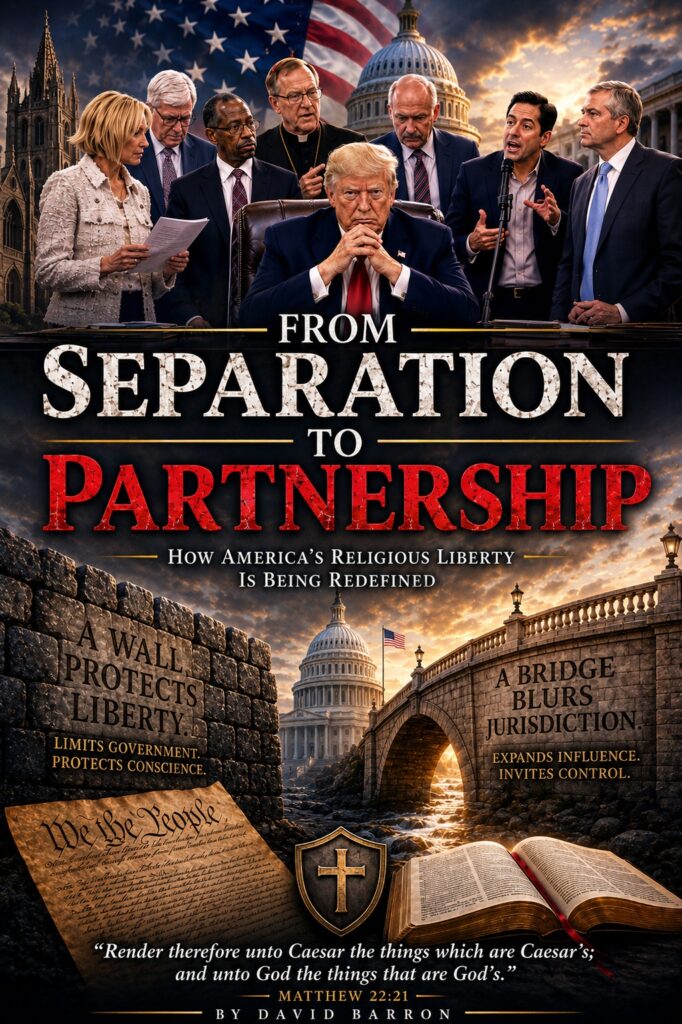
From Separation to Partnership
How the Presidential Religious Liberty Commission Redefines Religious Liberty
Is America preserving liberty of conscience—or replacing constitutional restraint with a closer institutional partnership between government and religion?
The Question Before America
Religious liberty has never meant that faith must be hidden from public life. Christians remain free to preach, persuade, serve, vote, teach, and address the moral questions of the nation.
The deeper question is one of jurisdiction: Where did God place the limits of civil government? This booklet examines whether the Commission’s proposed “bridge” between church and state preserves America’s historic protection of conscience—or changes the very meaning of religious liberty.
Biblical Foundation
Christ distinguished His kingdom from the kingdoms of this world. Civil government bears the sword for civil wrongs; it was never entrusted with authority over faith, worship, doctrine, or conscience.
Constitutional History
Roger Williams, Isaac Backus, John Leland, James Madison, Thomas Jefferson, and the First Amendment defended a common principle: civil authority must stop at the conscience.
Present-Day Warning
The report’s shift from a “wall” to a “bridge,” together with expanded partnerships and funding, raises a serious question: when government partners with religion, does it become an arbiter of religion?
What the Booklet Examines
- Liberty of Conscience Begins with God
- America’s Founders Recognized the Limits of Civil Government
- Religious Liberty Redefined
- Two Competing Historical Understandings
- Vatican II and the Modern Understanding of Religious Liberty
- Does the Commission Preserve America’s Historic Understanding?
- The Final Test of Liberty of Conscience
- Selected Commission Statements
- A Biblical and Historical Timeline
“Render therefore unto Caesar the things which are Caesar’s; and unto God the things that are God’s.”
Matthew 22:21
The conscience belongs to God. Caesar has no rightful claim upon it.
Why the “Wall” Matters
A constitutional wall does not prevent believers from entering public life. It separates ecclesiastical power from civil power. It allows religion to influence society through truth and persuasion while preventing the government from defining doctrine, compelling worship, favoring particular religious bodies, or turning public support into public control.
Once government funds, recognizes, promotes, or formally partners with religious institutions, it must establish qualifications and standards. It must decide who is eligible, which activities are approved, and what practices fall outside acceptable limits. In that process, the state risks becoming the judge of religious legitimacy—the very progression America’s constitutional restraints were designed to prevent.
Read the Evidence. Consider the Question.
Download the booklet and examine the issue through Scripture, American history, the Constitution, papal statements, the Commission’s own language, and Bible prophecy.